
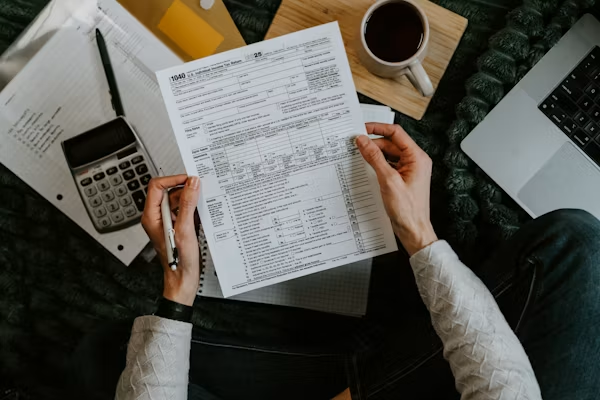
Being self-employed gives you more control over your work, but it also means you are responsible for maintaining your records and dealing with your own tax obligations.
One of the most effective ways to manage your tax position is to keep accurate records of your income and business expenses throughout the year.
HMRC allows self-employed taxpayers to deduct qualifying business expenses when calculating taxable profit. If your turnover was £40,000 and you had £10,000 of allowable expenses, for example, your taxable business profit before considering other relevant factors would generally be based on the remaining £30,000.
Common allowable expenses can include office costs, business telephone expenses, certain travel costs, insurance, advertising, professional fees and relevant training.
Where an expense has both business and personal use, you should normally claim only the business-related proportion. HMRC provides the example of a mobile telephone used for both personal and business calls, where only the business element is allowable.
If you work from home, you may also be able to claim qualifying costs. Depending on your circumstances, this may involve calculating a reasonable proportion of actual household costs or using simplified expenses.
Simplified expenses allow eligible sole traders and qualifying partnerships to use flat rates for certain costs such as working from home and some vehicle expenses. Limited companies cannot use these simplified expense rules.
For qualifying home working, HMRC’s simplified-expense rates currently depend on the number of business hours worked from home each month. These flat rates do not include telephone or internet costs, which may need to be considered separately.
You should also retain supporting evidence for your expenses. Digital photographs or scanned copies of receipts can make record keeping easier and reduce the risk of documents being lost.
Planning for your Self Assessment bill is equally important. Setting aside part of your income throughout the year can prevent a large January tax payment from becoming a cash-flow problem.
Some taxpayers may also be required to make payments on account, meaning the amount payable in January can be higher than expected if no money has been reserved.
Another important change for self-employed people is Making Tax Digital for Income Tax. From April 2026, qualifying sole traders with income above the relevant threshold need to maintain digital records and submit quarterly updates through compatible software.
This makes regular bookkeeping even more important than before.
At EasyFig, we can help organise your self-employed income and expenses, maintain your bookkeeping and prepare your Self Assessment Tax Return accurately.
Want to make sure you’re managing your self-employed taxes correctly? Book a free consultation with EasyFig today.